

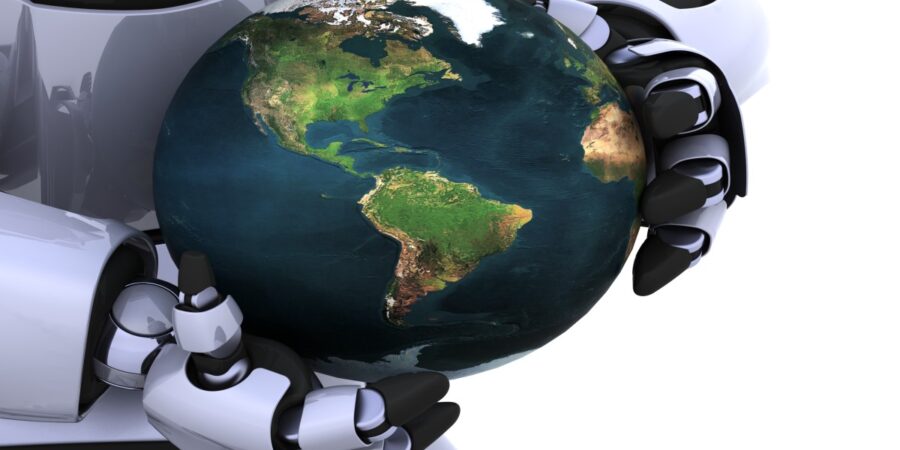
Technology has been a character in determining human civilization. Since the discovery of the wheel up to the emergence of the internet, technology has transformed the way societies operate, interact and develop. We are at the brink of another revolutionary age today, and it is an age of Artificial Intelligence (AI). AI is by far considered the most disruptive and powerful force in determining the future of technology in a world of modern innovations.
Artificial Intelligence has become a current reality once it was only a far-fetched notion that belonged to the science fiction world. It is integrated into daily equipment, commerce, health infrastructures, and infrastructure in the world. Whether it is routine tasks being automated or machines being able to learn and make decisions, AI is redefining the art of creating and using technology. The future of AI is going to extend its impact on the future of technology as the technology continues to evolve, providing new possibilities and at the same time, creating new complex challenges.
This blog discusses the real definition of Artificial Intelligence, why it is accelerating technological advancement, the sectors it is changing, the ethical concerns it brings, and the future of the world in an AI-powered world.
Understanding Artificial Intelligence
Artificial Intelligence is a concept that denotes capability of machines and software systems to simulate human mental processes like learning, reasoning, perception, solution solving and decision making. Simply put, AI helps computers to think and act wisely by analyzing and identifying trends and making reasonable judgments.
AI is fundamentally constructed around three elements, namely algorithms, data, and computation power. The algorithms give direction, the learning material is provided by data and the processing is fast and efficient through the use of computing power. With such components operating together, machines will be able to do tasks that previously needed human intellect.
A large majority of the current AI uses machine learning, a subdivision of AI that enables systems to evolve their performance with time without any explicit programming. Machine learning models are also not required to abide by specific rules, instead they learn and evolve as they are fed with new data. It is this ability that drives voice assistants, recommendation systems, facial recognition, self driving cars, and medical diagnostic devices.
With the continuous learning and advancement of the AI systems, they are more accurate, efficient, and capable, which makes them a necessary part of the technological future.
Artificial Intelligence as a Catalyst for Future Technology
The future of technology cannot exist without the advance of Artificial Intelligence. With digital transformation becoming increasingly faster in any industry, AI is now the backbone on which the next generation technologies are anchored.
Automation and Operational Efficiency
Intelligent automation is one of the most influential works of AI. The repetitive, time-consuming, and data-intensive tasks can be done faster and more accurately by AI-driven systems and leave the humans to creative, strategic, and decision-based activities.
AI robotics are used in manufacturing to optimize production lines, minimize errors, and enhance safety. In business, AI is used to automate customer support, financial analysis, supply chain management and administration. Not only do these systems enhance productivity, but also lower the cost of operations, and enhance uniformity.
With the maturity of AI technology, automation will be smarter and more cooperative, and machines and humans will be able to cooperate harmoniously. This will be necessary in the new technological ecosystems that will require quickness, scalability, and robustness.
AI-Driven Innovation Across Major Industries
Healthcare Revolution
The healthcare industry is radically changing due to Artificial Intelligence, making the process of diagnostics, treatment planning and patient care better. Medical images can be analyzed using AI algorithms, and the early detection of a disease and the assistance of a doctor in making a correct clinical decision is possible.
Machine learning-based predictive analytics can be used to detect health threats before they manifest in preventive care. AI is also increasing the speed of drug discovery, decreasing the time and cost of the development of a new treatment.
AI will become a significant part of individual medicine in the future. Using genetic data, lifestyle data, and medical history, AI systems will assist in creating the personalized treatment plan of individual patients, enhancing the outcome and quality of care.
Finance and Banking Transformation
Artificial Intelligence is fast becoming an adopted approach in the financial sector to improve security, efficiency and customer experience. In order to detect fraud, assess credit risk and prevent financial crimes, AI systems monitor transactions in real time.
AI is applied in algorithmic trading, which processes trends in the market and allows them to trade much faster than humans. Chatbots and virtual assistants enhance customer service by offering immediate customer support and individual financial recommendations.
With the further development of AI technology, financial inclusion will be enhanced, cybersecurity reinforced, and the trust in the world financial systems will increase.
Education and Personalized Learning
The introduction of Artificial Intelligence is a significant change in education. Artificial intelligence learning systems will tailor the content to specific learning styles and track progress and suggest improvement based on performance.
Machine learning enables virtual tutors that make education more accessible, interactive and engaging. Students get a chance to be given real-time feedback and the educators are in a position to get to know the learning gaps and achievements.
Going forward, AI will be essential in reskilling and upskilling the human resource. The training system with AI will assist people to gain new skills necessary in the workplace in the future, as technology advances.
Machine Learning: The Engine of AI Advancement
Modern Artificial Intelligence is controlled by machine learning. It allows the systems to work with huge volumes of data, discover the patterns and state predictions with more and more accuracy.
Machine learning has various forms, which are supervised learning, unsupervised learning, and reinforcement learning. Each of them is used to accomplish different tasks, such as classification and pattern recognition to making decisions in intricate settings.
Recommendation engines on streaming platforms, fraud detection systems in finance and navigation systems in autonomous vehicles all run on machine learning. With the increase in data availability and the rise in computing power, machine learning models will be even more advanced to speed up AI-driven innovation.
Artificial Intelligence and Emerging Technologies
There is no existence of AI in a vacuum. It has a potential that can be realized when it is used with other emerging technologies.
AI and the Internet of Things (IoT)
The combination of AI and IoT allows smart spaces. AI takes data gathered by interconnected devices to optimize energy consumption, make things safer, and better. Connected healthcare systems, smart homes, and intelligent cities are based on this potent combination.
AI and Blockchain
Blockchain is more transparent and secure, whereas AI is more intelligent and automated. They all facilitate safe data transfer, detecting fraud, effective supply chain management, and verifying identity online.
AI and Extended Reality (XR)
With artificial intelligence, virtual and augmented reality are enhanced with intelligent avatars, real-time interaction and dynamic environments. This combination is changing the entertainment, professional training, remote collaboration, and live learning experiences.
Ethical Challenges and Responsible AI
Even though the potential of Artificial Intelligence is enormous, it is not unaccompanied by serious ethical and social issues. Such problems like data privacy, algorithm bias, job loss, and transparency should be dealt with in a responsible manner.
With the increased autonomy of the AI systems, accountability and fairness become important. To stay within human values and rights, governments, organizations, and technology leaders need to develop ethical frameworks, regulations, and governance models that would guarantee that AI development does not conflict with human values and rights.
The success of AI in the future is not necessarily based on technological development but also on trust, inclusivity, and responsible innovation.
AI and the Workforce of Tomorrow
Artificial Intelligence is transforming the work nature. Although some jobs are likely to be automated, other areas that have shown opportunities through AI development, data science, and cybersecurity in addition to emerging technology areas.
Digital literacy, flexibility and the capacity to work with smart machines will be required in the future workforce. The ongoing learning and reskilling will be necessary as the AI technology progresses.
Instead of displacing people, AI can also expand human potential, improving human productivity, creativity, and problem-solving in any industry.
The Global Impact of Artificial Intelligence
AI has turned into a phenomenon all over the world that can be seen in the economy, geopolitics and innovation ecosystems. The nations that have been putting great investments in AI research and development are also enjoying strategic benefits in technological leadership.
Such collaboration on the global level will be necessary to tackle ethical concerns, open research and equal access to the benefits of AI. It is possible to reduce the problem of abuse of AI by promoting shared governance, which would enable the optimal use of AI to society.
The Road Ahead: Embracing the AI Future
Artificial Intelligence is without a doubt the future of technology. With the increasing penetration of AI into life, it will lead to the development of smarter infrastructure, science and sustainable development.
The next ten years will most likely see the greatest innovation in AI as machines will learn more quickly, have the ability to process a greater amount of data, and integrate with other highly developed technologies. Those who are strategic in the implementation of AI will be at the forefront of the digital revolution and those who do not embrace change will become left behind.
Conclusively, humanity and smart machines are the way to go in the future of technology, as they will work to resolve complicated issues and make the world a better place.
Conclusion
Artificial Intelligence is defining how technology would look like in the future in ways never thought of before. In the medical sector, finance, education, and intelligent systems, AI is leading to efficiency, innovation, and development. AI is reinventing the possible thanks to machine learning, combined with new technologies.
Nevertheless, responsible creation, ethical management, and human design are the determinants of the successful future of AI. Thoughtfully, Artificial Intelligence can be the savior of humanity, a new creative boost, and a future in which technology does not displace people but serves them.

Leave a Reply